Hemistola chrysoprasaria Contents Description Biology Subspecies Notes References External links Navigation menuSmall emerald on UKmothsLepiforum.de52331272467445430d5e4dec9-8159-4190-a3a8-360dfcda7b6e1991179430528107737132096903924NHMSYS0021144321934942expanding ite
HemitheiniMoths of EuropeInsects of EuropeInsects of TurkeyTaxa named by Eugenius Johann Christoph EsperMoths described in 1794Geometrinae stubs
mothGeometridaeEuropeIberian PeninsulaRussiaUral MountainsNorth AfricaAsia MinorTranscaucasiaRussian Far EastSiberiaAmurUssuriTian Shanwingspan
Hemistola chrysoprasaria | |
|---|---|
 | |
 | |
Scientific classification  | |
| Kingdom: | Animalia |
| Phylum: | Euarthropoda |
| Class: | Insecta |
| Order: | Lepidoptera |
| Family: | Geometridae |
| Genus: | Hemistola |
| Species: | H. chrysoprasaria |
Binomial name | |
Hemistola chrysoprasaria (Esper, 1794) | |
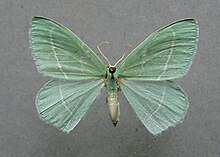
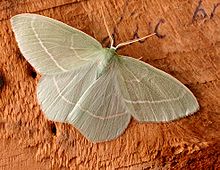
Hemistola chrysoprasaria, the small emerald, is a moth of the family Geometridae. The species can be found in all Europe including the Iberian Peninsula and Russia East to the Ural Mountains, North Africa, Asia Minor, Transcaucasia and the mountains of Eastern Asia (Russian Far East, Siberia), (Amur, Ussuri) and China Tian Shan (as form lissas)
Contents
1 Description
2 Biology
3 Subspecies
4 Notes
5 References
6 External links
Description
The wingspan is 28–32 mm. Both forewings and hindwings are light-green coloured, but fade but with increasing life span to yellow-green to yellow-white.There is an outer and a fainter inner, slightly curved and continuous, white cross line on the front wings. The inner (antemedian) is strongly curved and usually with two small, slight teeth directed distad, the
outer (postmedian) is nearly parallel with distal margin, not dentate.The outer line continues on the hindwing.There is no discal stain. The antennae of the males are slightly combed, those of females short ciliate. In Amur and Ussuri the specimens are often large and with the lines rather widely separated.lissas diifers in the shape of the hindwing, which is rounded instead of elbowed[1]
Biology
The moths fly in one generation from June to August. [1].
The larva feed on Clematis vitalba.
Habitats include edges of woods, hedges areas as well as gardens and parks. It prefers warm slopes.
Subspecies
H. c. chrysoprasaria Central Europe, South Europe, South Russia, South Urals - SouthEast Siberia, Turkey, Caucasus, Georgia,
H. c. lissas Prout, 1912 Tianshan
H. c. intermedia Djakonov, 1926 mountains (South Siberia)
H. c. occidentalis Wehrli, 1929 South Spain, South Portugal, Morocco, Algeria, Tunisia
Notes
^ The flight season refers to the British Isles. This may vary in other parts of the range.
References
^ Prout , L.B. 1912–16. Geometridae. In A. Seitz (ed.) The Macrolepidoptera of the World. The Palaearctic Geometridae, 4. 479 pp. Alfred Kernen, Stuttgart.
External links
 | Wikimedia Commons has media related to Hemistola chrysoprasaria. |
- Small emerald on UKmoths
- Lepiforum.de
 | This Geometrinae-related article is a stub. You can help Wikipedia by expanding it. |

